The First Push: Why Your Base Decides What Happens Next
Most confrontations do not start with a punch. They start with a shove — a hand flat on your chest, a shoulder that drives into you at a doorway, someone grabbing your arm to stop you walking away, a hard bump in a packed metro carriage that was no accident. What happens in the half-second after that push often decides everything that follows. Go down, and the situation gets harder to recover from. Stay on your feet, and you keep every option you had a moment earlier — talking, creating space, or simply leaving. This is not about winning a confrontation. It is about the physics of staying upright long enough to walk away from one.
Why the push comes first
A push is a cheaper opening move than a punch. It carries less social risk for the person doing it — in a crowd, in a bar, at a doorway, a shove can be waved off as an accident or a moment of frustration in a way a closed fist cannot. It also tests you: how you react to being pushed tells an aggressive person a lot about what is likely to happen next. And plenty of shoves are not aggression at all — a crowded platform, a queue that surges forward, a stranger who grabs your sleeve to get your attention. The response your body needs is the same regardless of intent: stay upright, stay aware, stay able to move.
What your base actually is
Underneath the karate vocabulary, a stance is applied physics. Your base of support is the outline connecting the points where your body touches the ground — standing, that means the space between and around your two feet. Your center of gravity is the point where your body's weight balances, roughly behind your navel. You stay standing as long as that center of gravity's downward line falls inside your base. Push hard enough to move it outside that outline, and you either take a step to rebuild your base underneath it, or you fall. That is the entire mechanism — no different for a person than for a table.
What stance training actually changes
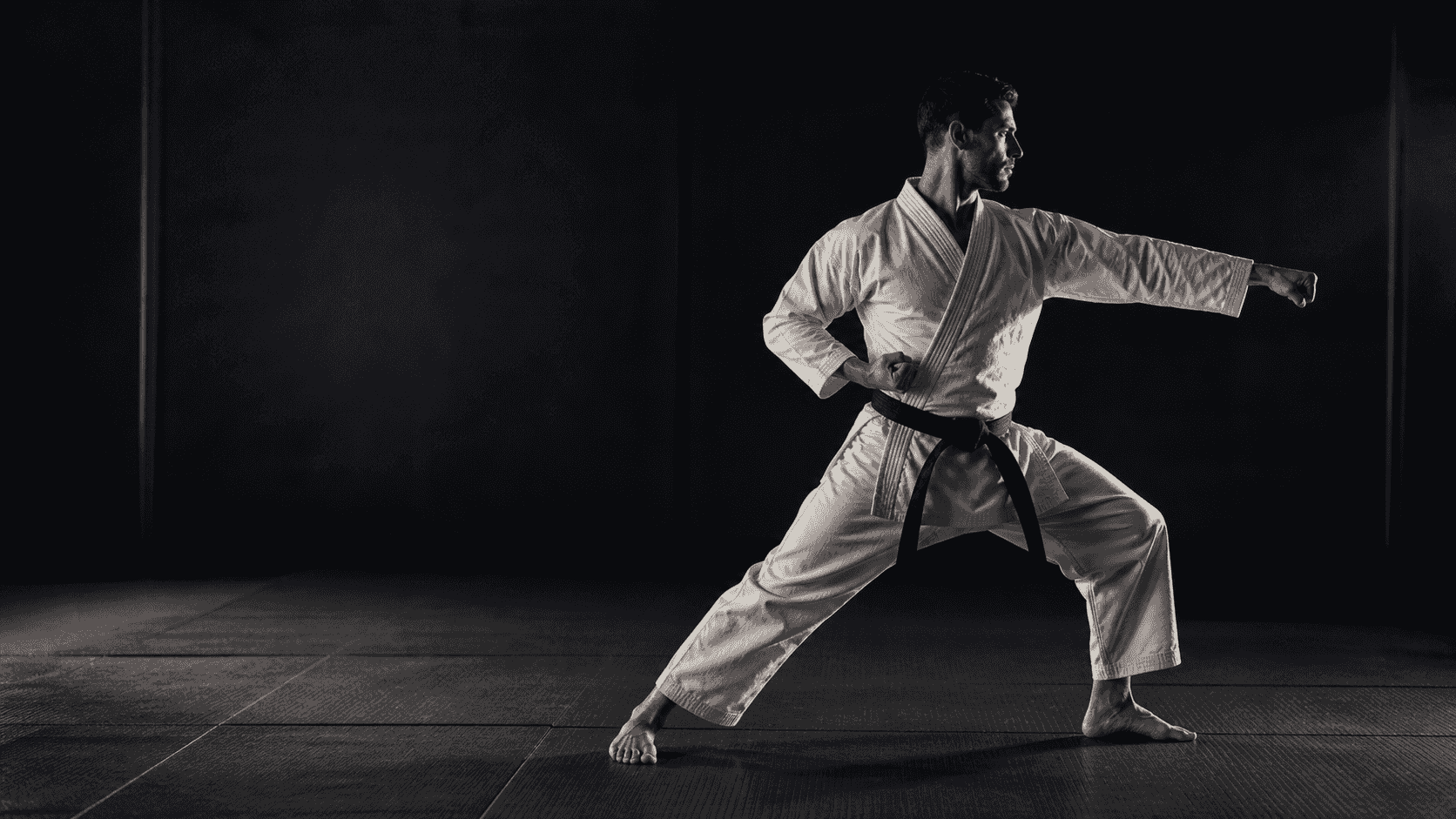
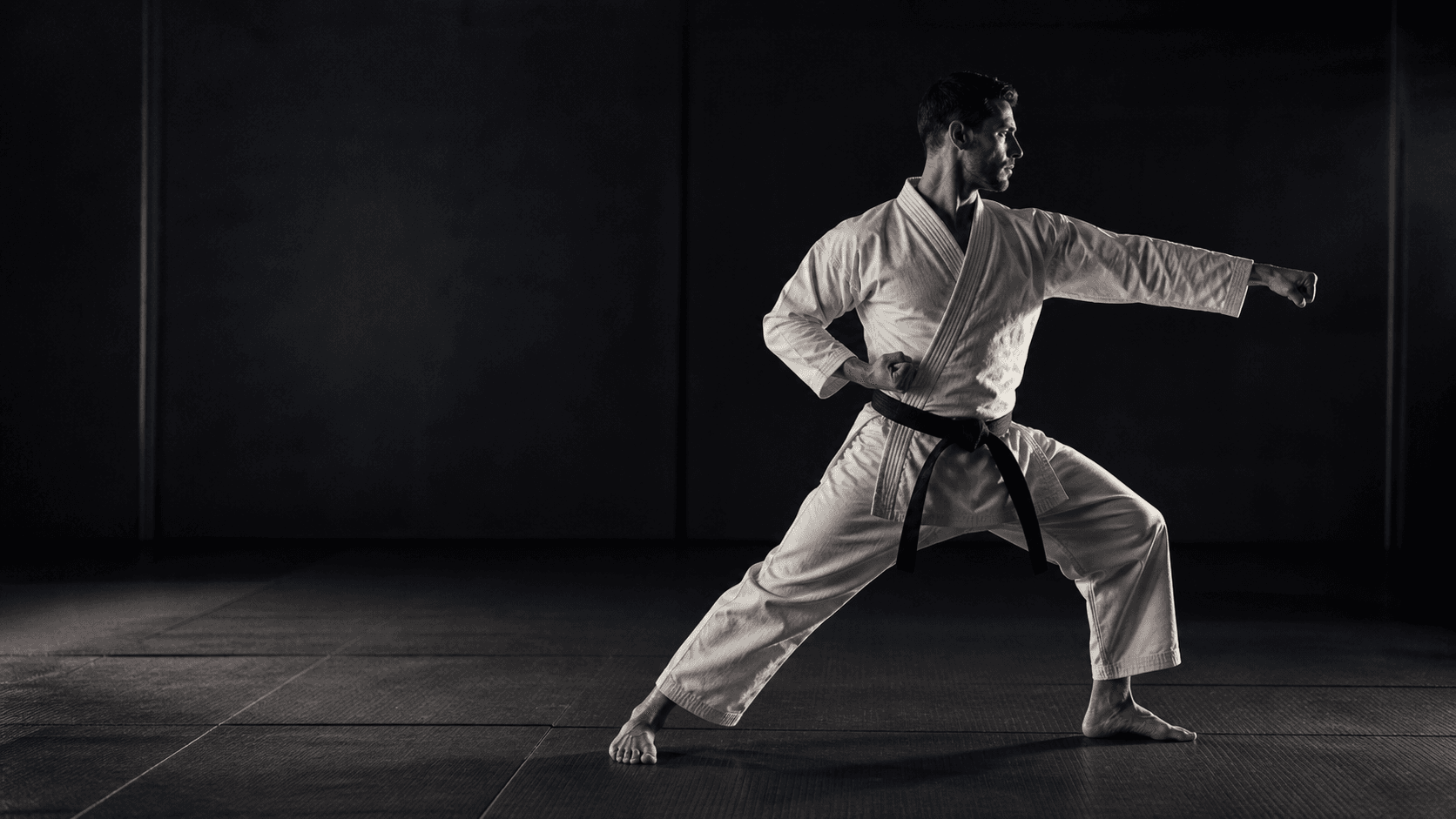
Karate stances look formal, but the purpose is unglamorous: widen the base and lower the center of gravity, so a lot more force is needed to push your balance outside it. Bent knees act as shock absorbers, taking a shove into the joints and the ground rather than passing it straight up your spine. None of this is about looking rooted for its own sake. A wider, lower base is simply harder to move.
Feet together is the easy target
Stand with your feet together, weight high and even, and a moderate push from almost any direction can topple you — your base in that direction is only as wide as your shoe. Stand with one foot slightly back, knees soft, weight a little lower, and the same push has to work far harder, because your base now extends further in the direction it is coming from. This is worth knowing because feet-together is exactly how most people stand while distracted — waiting for a bus, looking at a phone, arguing with someone at close range.
Rigid is not the same as strong
The instinct under a shove is often to lock your knees and lean back into it, meeting force with force. It usually backfires. A straight, rigid body acts like a lever — push the top of it and the whole structure tips. Soft knees and a slightly lower center of gravity let you absorb a push and redirect it into the ground instead of it passing straight through you. Strength has surprisingly little to do with it; structure does most of the work.
Staying up is not the goal, leaving is
None of this is about winning an exchange. The point of staying on your feet is to preserve your ability to do the things that actually keep you safe — create distance, keep your voice steady, move toward other people, leave. Going to the ground is where a situation becomes genuinely dangerous, especially on a hard surface or in a crowd, because you lose mobility and the ability to see what is happening around you. A stable base is what buys you the choice to disengage rather than react.
Be honest about what this does and does not do
A stable base built from a few karate classes will not make you immovable. Against someone much larger, someone determined, or a hard shove aimed to genuinely knock you down, you can still go down — training shifts the odds for an ordinary, unplanned push, it does not guarantee an outcome against real force or intent. Nobody should walk away from a few classes believing otherwise. The value here is modest and specific: a more automatic, low, stable response to unexpected contact, and nothing more.
If it goes further
If a shove is the opening of something you cannot simply walk away from, do not try to handle it alone — move toward other people, raise your voice, and call 112, Turkey's national emergency number, as soon as you safely can.
Why this needs to be practiced, not just understood
Reading this will not put it in your body. Under real adrenaline, conscious thought slows down, and what actually shows up is trained, repeated movement — which is the entire reason stance work gets drilled over and over in class rather than explained once and left there. The goal is a base that finds itself under you without you having to decide to build it.
Kartal Karate Academy runs a free trial class for anyone who wants to feel this rather than read about it — children and adults, no experience required. Register at karatekartal.fit/en/register.